
Wattage Buys Throughput, Not Quality
The most common mistake new makers make is assuming a higher wattage produces better engravings. It does not. A 40 W tube and a 100 W tube will both engrave a name into maple, and if both are focused properly the 40 W result may even look cleaner, because less power means less charring and less heat spread around fine lettering. What wattage actually buys you is speed on cuts, thickness capacity, and the ability to run dense raster jobs without babysitting them.
So the right question is not "how much power is best" but "what do I make, how thick is it, and how many do I make at a time." A crafter selling engraved keychains and ornaments has almost no need for triple-digit wattage. A maker cutting 6 mm plywood box kits in batches of forty, or running full-bed leather panels for a bag business, will lose hours every week to an underpowered machine. Match the tube to your material mix, and spend the savings on a better extraction setup.
What the 40 W Class Does Well
A 40 W class machine is the honest starting point for most home craft businesses. It engraves wood, leather, paper, card, glass, anodized aluminium and slate comfortably, cuts paper and cardstock at speed, and handles thin plywood, 3 mm MDF, felt, fabric, thin acrylic and mylar without complaint. For a shop built on personalization — names, dates, monograms, photo transfers — there is very little you cannot do.
The practical limits appear when you want to cut thicker stock. Expect to make multiple passes on 6 mm plywood or acrylic, and accept that the cut edges will be darker because more passes mean more heat in the same kerf. That is fine for parts you will paint or edge-finish, and annoying for parts you want to sell as-is. Cutting speed is the other constraint: if your product is a flat-pack item that you cut forty at a time, a 40 W tube turns a two-hour job into most of a day.
Choose this class if your output is mostly engraving on purchased blanks, your materials are under 4 mm, and your workspace is a spare room, a garage corner, or a shared studio where noise and heat matter.
What 60 W Adds
Sixty watts is the sweet spot for a serious home workshop. It roughly halves cut time compared with 40 W on the same material, which means 5–6 mm plywood and acrylic become single-pass jobs at usable speeds rather than slow multi-pass chores. That single change is often the difference between a shop that can take a fifty-piece wholesale order and one that has to turn it down.
It also gives you headroom as the tube ages. CO2 tubes lose output gradually over their life, and a machine specified at 40 W has almost no margin before jobs that used to work stop working cleanly. A 60 W tube with the same degradation still performs at a level a 40 W tube delivered new. That headroom is worth real money over two or three years of selling.
Engraving quality does not suffer if you dial the power down, which is the key point many people miss. Higher wattage does not force you to run hot; you simply use a lower percentage for the same result, and you have the reserve available when a job calls for it. Machines in this class are the natural home for mixed work — leather goods one day, plywood signage the next, acrylic keychains on the weekend.
What 100 W and Above Unlocks
Above about 100 W you move into production territory. The gains are straightforward: thicker material in one pass, faster full-bed raster jobs, and the ability to cut dense hardwoods and thicker acrylic at speeds that make batch work economically sensible. If you are producing flat-pack furniture components, thick MDF jigs and templates, or large-format signage, this is the class that stops the machine from being the bottleneck.
The trade-offs are real for a home setting. Higher wattage means a longer tube, a larger machine footprint, a chiller rather than a simple water pump, more heat into the room, and a more serious extraction requirement. It frequently means a dedicated circuit as well. None of these are deal-breakers in a garage workshop, but they are the difference between "plug it in and make things" and "plan a room around it."
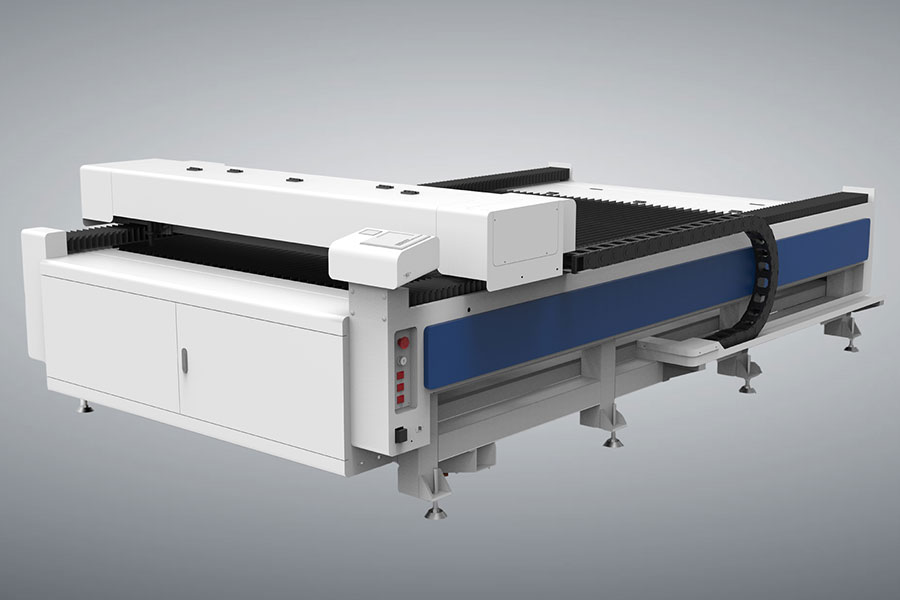
For makers scaling into genuine production — a full-time personalization business or a small furniture and signage shop — a high-power flatbed such as the CM1325H, which goes up to 680 W, or a large-format machine like the CM1325 or CM1625, is the right endpoint rather than the starting point.
| Power class | Engraves easily | Cuts comfortably | Watch out for |
|---|---|---|---|
| 40 W | Wood, leather, glass, paper, slate, anodized aluminium | Paper, card, felt, 3 mm ply/MDF, thin acrylic, mylar | Slow multi-pass on 6 mm stock |
| 60 W | All of the above, faster raster | 5–6 mm ply, MDF and acrylic single pass | Needs proper extraction and cooling |
| 100 W+ | Dense raster at full-bed speed | Thicker hardwood, thicker acrylic, production batches | Footprint, chiller, power and venting |
The Hidden Costs of Going Bigger
Budget beyond the machine. A larger tube needs reliable cooling — a chiller sized to the tube rather than a bucket and pump — and that is both a purchase and an ongoing electricity cost. Extraction scales too: more power means more smoke per minute, and an inadequate fan will fog a room in minutes. Ducting to outside, or a filtration unit sized for your actual duty cycle, is not optional at this level.
Space is the cost people forget. A big flatbed needs clearance on all sides for loading sheet material, plus somewhere to store the sheet itself. Measure your longest material, add handling room, and check doorways before you order. Electrical supply matters as well — confirm what your workshop circuit can deliver before committing.
Operating cost per hour is modest for any of these classes, but it is not zero: tube life, chiller maintenance, lens replacements, and extraction filters all add up. Model your cost per part including a share of tube replacement, because a tube is a consumable with a finite life, not a permanent component.
Choosing for a Home Workshop
Buy for the job you have now plus the one you can clearly see coming. If your current orders are engraved blanks, buy a smaller machine and spend the difference on a rotary attachment, a good extraction setup, and material stock — those will grow your revenue faster than unused watts. If you already turn down cut-heavy orders because your machine is too slow, buy the power.
A compact model such as the M3050 Breeze suits a spare-room setup and light personalization work; an M4060E Cyclone and M6090E cover the plywood-and-acrylic mix that most Etsy shops eventually land on; a CM1390E Elite or a CM1625 is where batch production and larger sheet sizes start to make sense. Whatever you pick, standardise your material library from day one and log every good setting you find.
- Mostly engraving purchased blanks — 40 W class
- Mixed engraving plus 5–6 mm cutting — 60 W class
- Batch cutting, thick stock, full-time output — 100 W and up
- Always budget chiller, extraction, and space before the machine
FAQ
Q: Will higher wattage ruin fine engraving detail?
No, as long as you reduce the power percentage to suit the job. Detail is governed by spot size, focus, scan interval and material response, not by tube rating. In practice a bigger tube can even help fine work, because you can run faster at low power and still get a consistent burn, which reduces heat soak and reduces the fuzzy halo around small letters.
Q: Is a 40 W machine enough to start a side business?
For most personalization businesses, yes. The overwhelming majority of custom orders — cutting boards, ornaments, leather goods, glassware, pet tags, slate coasters, paper goods — are engraving jobs on thin stock, and a 40 W tube handles all of them. You will feel the limit only when customers start asking for thick cut items or volume pricing, and by then the machine will have paid for the upgrade.
Q: Does more power mean more maintenance?
Indirectly, yes. Higher wattage machines use chillers that need coolant changes and filter cleaning, they generate more smoke so extraction filters load faster, and they tend to run longer hours, so belts, lenses and mirrors wear sooner. None of it is onerous, but plan a weekly optics check and a monthly mechanical check regardless of which class you buy.
Pick the Power That Matches Your Order Book
Decide with a list, not a feeling: write down your five best-selling items, the material thickness for each, and how many you make per week. That sheet will point at one power class almost immediately. When you are ready to compare bed sizes and configurations side by side, the Redsail laser cutter range spans compact craft machines up to high-power flatbeds. For larger-format production work, see the HF Laser cutter range.

- National hotline: +86-531-86516855/56/57
- Enterprise mailbox:sales@redsaillaser.com
- Address: Room 402E, Tower D, Yinhe Building, 2008 Xinluo Avenue, Shunhua Road Subdistrict, Jinan Area, China (Shandong) Pilot Free Trade Zone


Redsail Tech Co. © 2002-2026. All Rights Reserved.